


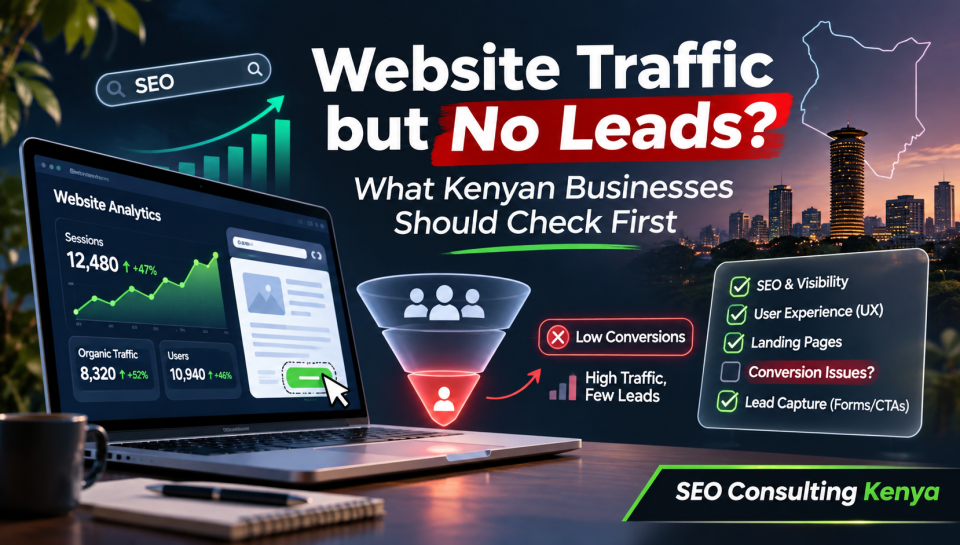
Website Traffic but No Leads? What Kenyan Businesses Should Check First
Your website is getting traffic. Search Console records clicks, your marketing reports show visitors, and perhaps rankings are improving. Yet the enquiries that matter to your business are missing. Should you invest in more SEO, spend on advertising, or redesign the website? Not until you know where potential customers are being lost.
A traffic problem and a lead-generation problem may look identical in a monthly report, but their solutions are different. The first calls for attracting the right visitors; the second requires understanding why visitors are not becoming genuine enquiries. This guide shows how to diagnose five possible leaks, measure the right outcomes, and decide what to fix before increasing your marketing budget.
Key takeaways
- Traffic is evidence that people arrived, not evidence that the right people arrived.
- Measure submitted enquiries and qualified leads separately from clicks on WhatsApp, phone or contact buttons.
- Investigate visitor intent, page relevance, trust, contact friction and sales follow-up in sequence.
- Diagnose important landing pages and acquisition channels individually; sitewide averages can hide the real problem.
- Fix the weakest verifiable step before spending more to increase traffic.
Why a busy website can still be a poor sales channel
Consider two hypothetical Kenyan service businesses. One receives 10,000 monthly visits and 20 qualified enquiries. Another receives 1,500 visits and 45 qualified enquiries. Their qualified-enquiry rates would be 0.2% and 3% respectively. Those figures are illustrative, not agency client results, and they do not account for differences in deal value or sales cycles. They make one point: visits and commercial opportunity are not interchangeable.
High visitor counts may come from informational blog posts, irrelevant geographic markets, job seekers, students, competitor research or search terms that do not express buying intent. Conversely, a smaller group of visitors looking for a specific service in Nairobi may be much closer to contacting a provider. Neither audience is inherently useless: the article reader may become a buyer later. But treating both groups as identical obscures the business decision.
The five-stage Traffic-to-Revenue Leak Framework
Use this framework as an investigation, not a claim that every website has all five problems. Start with evidence you can verify, then work from the earliest unresolved failure toward the final customer outcome.
1. Attraction: Are the visitors potential buyers?
Open Google Search Console and examine the queries and landing pages responsible for search clicks. Are visitors finding an article that explains a topic, or a service page that answers a purchase question? Check whether the queries reflect the places you serve, the services you actually sell and the commercial problems you solve.
For example, a Nairobi accounting firm might attract visitors searching for the meaning of tax terminology while failing to reach companies searching for outsourced bookkeeping. Both kinds of traffic can be relevant, but only one has an obvious near-term service enquiry opportunity. Segment by query intent before deciding that the entire website has a conversion problem.
2. Expectation: Does the page deliver what the visitor came for?
Imagine searching for a quote for commercial kitchen equipment and landing on an article that gives broad appliance maintenance tips. Even a polished page can disappoint if its offer does not match the query. Compare the search phrase, page headline, opening paragraphs, pricing or quotation guidance and the next action. They should describe one coherent customer journey.
A useful test is to show the page to someone unfamiliar with the business and ask three questions: What does this company provide? Who is it for? What should you do next if you want to buy or enquire? If the answers are unclear, adding another promotional button may not help.
3. Confidence: Is there enough reason to trust the offer?
A visitor may understand the service yet hesitate because the page leaves important questions unanswered. Explain scope, process, service location, delivery arrangements, expected next steps and relevant terms. Where available, include authentic case studies, appropriately attributed reviews, clear contact details and credible examples of work. Do not invent testimonials, figures or guarantees.
For higher-value B2B services, visitors may need more than a short sales pitch. A decision-maker comparing SEO providers might want to understand deliverables, reporting, timelines, ownership of accounts and how performance will be evaluated. Addressing those questions may be more useful than adding another generic claim about being the best.
4. Action: Can an interested visitor actually enquire?
Test the enquiry process on a real mobile device and desktop browser. Submit the form, confirm the notification arrives, test the telephone link and open the WhatsApp conversation. Check what happens when a required field is omitted, the network connection is slow or the visitor changes direction. A prominent button is not a working conversion system.
Keep the initial request proportional to the service. A quotation enquiry may need a name, contact method and brief requirements; asking for an extensive project brief before the first conversation may create unnecessary friction. Baymard Institute’s research on e-commerce forms shows how form complexity can undermine usability, though an enquiry form should be tested in its own context rather than assumed to behave exactly like a checkout.
5. Follow-through: Does the business turn enquiries into opportunities?
The final leak can occur after the website has done its job. A genuine enquiry might arrive in an unmonitored inbox, sit unanswered on WhatsApp or be handled without recording the customer’s requirements. If the owner counts only completed sales, the site may appear to have no leads when the real problem is response speed, qualification or sales process.
For Kenyan businesses that receive enquiries through WhatsApp and phone calls, a click on a contact link is an indication of intent, not proof that a conversation began. Separate clicks, successful contacts, qualified enquiries, proposals and closed customers wherever your systems allow. That distinction prevents both false optimism and unfair blame on SEO.
A practical diagnostic table: match the symptom to the next test
| What you observe | Possible explanation | Next evidence to collect |
|---|---|---|
| Search clicks grow, enquiries remain flat | More informational or irrelevant traffic | Queries, landing pages and geographic mix |
| Service pages get visits but few contact actions | Weak offer clarity or insufficient trust | Page walkthrough and user feedback |
| Many contact-button clicks, few received messages | Broken hand-off or incomplete contact | Device tests and inbox/call logs |
| Forms are started but rarely submitted | Friction or technical errors | Submission tests and form error logs |
| Enquiries arrive but few become opportunities | Lead quality or follow-up gap | CRM notes, response times and qualification outcomes |
How to check the numbers without misleading yourself
Use Search Console to understand Google search visibility and search clicks. Use GA4 to understand website sessions, landing pages and measured actions. Use your contact inbox, call records or CRM to verify whether an enquiry actually reached the business. Google explains that the two analytics tools describe different parts of the customer journey, so their traffic totals need not match exactly.
GA4 recommends the generate_lead event for a submitted form or request for information, and also defines downstream events such as qualify_lead and close_convert_lead. A WhatsApp click could be recorded as a separate interaction; it should not automatically be labelled a completed lead. Implement tracking with consent and privacy requirements in mind, then validate events with real tests.
Calculate enquiry rates using consistent definitions
For a defined reporting period, enquiry rate = verified enquiries ÷ relevant website sessions × 100. Qualified-enquiry rate = qualified enquiries ÷ relevant website sessions × 100. Use the same period, consistent attribution rules and a documented definition of qualification. For example, 30 verified enquiries from 1,500 relevant sessions equals 2%. If only 12 met the sales team’s qualification criteria, the qualified-enquiry rate is 0.8%. These are illustrative calculations, not universal benchmarks.
Interpret these figures alongside lead value, sales-cycle length and sample size. A company selling high-value consulting engagements might need relatively few enquiries to achieve its commercial objective. Do not compare its conversion rate blindly with a low-value retail business.
Where should you spend your next marketing shilling?
The correct investment depends on which part of the journey is failing. If commercial searches barely reach your site, strengthen relevant service pages and acquisition strategy. If qualified visitors arrive but cannot complete a form, fix the contact experience. If enquiries reach your team but nobody follows up, repair that workflow before buying more clicks.
Use a simple prioritisation rule: choose improvements with strong supporting evidence, meaningful revenue potential, relatively low implementation effort and a result you can measure. A broken enquiry form is generally a more urgent intervention than changing the colour of a button. Rewriting irrelevant blog content may be less urgent than creating the service page a buyer actually needs.
A seven-day investigation plan
- Day 1: Define a genuine lead, qualified lead and customer for your business.
- Day 2: Reconcile website reports with actual forms, calls, WhatsApp conversations and CRM records.
- Day 3: Review top landing pages and Search Console queries for commercial relevance.
- Day 4: Test the main service pages, trust signals and offers with a first-time visitor.
- Day 5: Test every important enquiry path on mobile and desktop, including real receipt.
- Day 6: Identify the highest-impact verified leak and make one controlled improvement.
- Day 7: Record baseline measures and establish a sensible follow-up review period.
Seven days is enough for an initial diagnostic, not necessarily enough to prove an uplift. Low-traffic websites and long sales cycles often require longer observation. Preserve a record of what changed so later results can be interpreted responsibly.
What should you avoid doing?
Do not buy more traffic simply because your dashboard looks quiet. Do not redesign an entire website before testing whether its forms work. Do not treat all organic sessions as potential customers. Do not call every WhatsApp click a qualified lead. And do not attribute poor sales entirely to SEO without examining the sales team’s response process.
Just as importantly, do not force every visitor to make an immediate enquiry. Informational readers may need an educational next step such as a relevant guide, comparison or email resource. A commercial service-page visitor should have a direct, low-friction path to discussing the service. Audience-first SEO means respecting both journeys while measuring them separately.
Frequently asked questions
Is getting traffic but no leads always an SEO problem?
No. SEO can attract visitors who are unlikely to buy, but poor enquiries can also result from weak offers, technical failures, unclear pages, missing trust information, incorrect measurement or slow sales follow-up.
What is a good website lead conversion rate in Kenya?
There is no single reliable rate that applies to every Kenyan company. Industry, service price, traffic intent, conversion definition and sales cycle all matter. Establish your own baseline and improve the qualified-enquiry rate and commercial outcomes rather than chasing an arbitrary percentage.
Can Google Analytics track WhatsApp leads?
GA4 can track a WhatsApp link click when configured appropriately. It does not, by that click alone, verify that the visitor sent a message or became a qualified customer. Additional enquiry records or CRM integrations are needed to assess those later steps.
Should I redesign my website if visitors are not enquiring?
Only after identifying the underlying problem. A redesign can be valuable when the site’s structure, accessibility, mobile usability or service presentation is fundamentally poor; isolated issues may be faster and less costly to fix without rebuilding.
Start with evidence, not another traffic target
A successful website should not merely be discovered. It should connect the right people to an offer they understand, trust and can act on, while giving the business a reliable way to respond. If your traffic numbers and enquiry records tell different stories, the next step is to find the disconnect—not assume that more of the same marketing will solve it.
SEO Consulting Kenya offers a free website SEO audit to help identify search visibility and website improvement opportunities. If your concern extends to lead quality, enquiry tracking or conversion performance, contact our team and describe what is happening between visits and enquiries.