



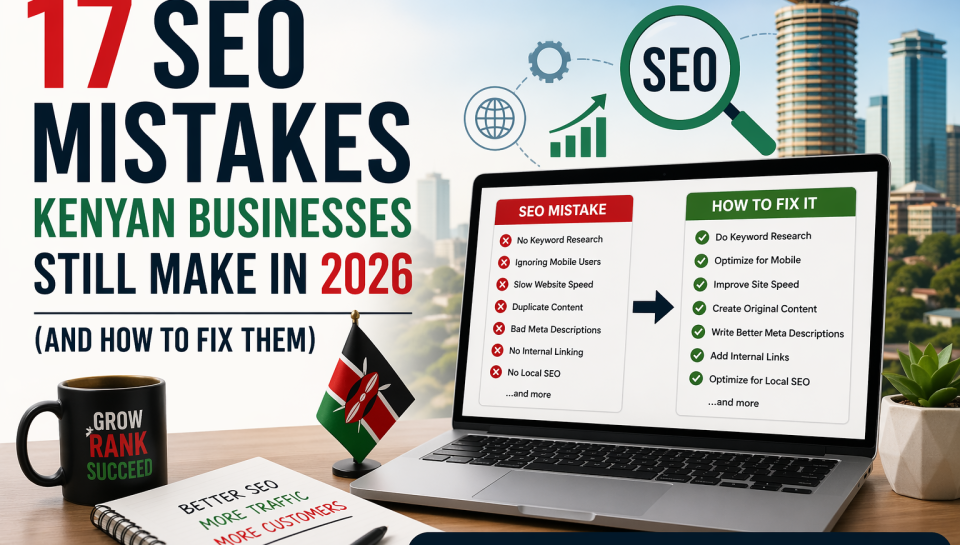
17 SEO Mistakes Kenyan Businesses Still Make in 2026 (And How to Fix Them)
Why SEO Still Matters for Kenyan Businesses in 2026
Kenyan businesses are operating in a digital environment that has become brutally competitive. Whether you run a law firm in Nairobi, a hardware shop in Eldoret, a tour company in Diani, or an online fashion store targeting customers across East Africa, visibility on search engines can either fuel your growth or quietly destroy your opportunities. In 2026, SEO is no longer just about ranking on Google. It is about being discoverable everywhere people search — Google Search, Google Maps, AI-powered search assistants, voice search, TikTok search, YouTube, and even AI-generated summaries.
The problem is that many Kenyan businesses still approach SEO like it is 2018. They stuff keywords into pages, buy random backlinks, and expect traffic to magically appear. Meanwhile, competitors investing in smart content strategies and technical optimization are dominating search visibility. According to global digital trends, more than 68% of online experiences still begin with a search engine. Kenya’s internet penetration has also continued to rise thanks to affordable smartphones and expanding 4G and 5G access. That means consumers are searching before making nearly every buying decision.
The Rise of AI Search and Local Discovery
AI-powered search results have changed how websites gain traffic. Google AI Overviews, ChatGPT browsing, Gemini, and voice assistants now summarize answers directly inside search experiences. If your content is poorly structured, outdated, or lacks authority, your website gets ignored entirely. Kenyan businesses that once depended on simple keyword rankings are now competing for visibility inside AI-generated answers.
Local discovery has become even more important. Someone searching “best nyama choma in Nairobi” or “affordable movers in Mombasa” expects immediate and hyper-local results. Businesses without optimized Google Business Profiles or localized content simply disappear from the conversation. Think of SEO like owning prime real estate in downtown Nairobi. If your shop is hidden behind dark alleys while competitors are on Kenyatta Avenue with bright signage, who gets the customers?
Why Kenyan SMEs Are Struggling Online
Many small and medium-sized enterprises in Kenya still believe SEO is optional or too technical. Some rely entirely on Instagram or TikTok traffic, forgetting that search traffic often converts better because users already have buying intent. Others hire cheap “SEO experts” who use outdated tactics that eventually harm rankings.
Budget limitations also play a role. Instead of building long-term SEO systems, businesses chase shortcuts. They publish low-quality articles generated in minutes, neglect technical maintenance, and ignore analytics completely. The result? Websites with little traffic, poor conversions, and almost zero visibility in competitive industries. The good news is that most SEO mistakes are fixable if identified early and approached strategically.
Mistake #1: Ignoring Local SEO Optimization
One of the biggest mistakes Kenyan businesses still make is treating local SEO like an afterthought. Imagine owning a beauty salon in Westlands but failing to appear when someone nearby searches “best salon near me.” That is lost revenue walking straight into your competitor’s doors.
Local SEO focuses on helping businesses appear in geographically relevant searches. Google increasingly prioritizes businesses with accurate local signals because users want fast, nearby solutions. Yet many Kenyan companies fail to optimize their location pages, business profiles, or local citations. Some do not even include their physical address consistently across platforms.
How Google Business Profile Impacts Visibility
A properly optimized Google Business Profile can dramatically improve local traffic. Businesses with complete profiles receive more calls, website visits, and direction requests compared to incomplete listings. Yet many Kenyan businesses leave important sections blank or fail to update operating hours and contact information.
To improve local SEO:
- Add accurate business categories
- Upload real business photos
- Encourage customer reviews
- Respond to reviews consistently
- Include localized keywords naturally
For example, instead of saying “best bakery,” say “best birthday cake bakery in Nairobi CBD.” These small adjustments help search engines connect your business with relevant local searches.
Mistake #2: Targeting the Wrong Keywords
Many businesses target broad keywords that are nearly impossible to rank for. A startup insurance agency trying to rank for “insurance” globally is competing against massive corporations with huge SEO budgets. That strategy is like bringing a bicycle into a Formula 1 race.
The smarter approach involves targeting long-tail and intent-driven keywords. Instead of “insurance,” focus on “affordable car insurance in Kenya” or “medical insurance for SMEs in Nairobi.” These keywords may have lower search volume, but they attract users who are closer to making purchasing decisions.
Understanding Kenyan Search Intent
Search behavior in Kenya has unique patterns. People often combine English, Swahili, and localized terms in their searches. Someone may search “cheap laptops Nairobi” instead of “affordable laptops Kenya.” Understanding these nuances can significantly improve SEO performance.
Keyword research tools like Semrush, Ahrefs, and Google Search Console help identify relevant search terms. Businesses should also study customer language patterns from WhatsApp messages, social media comments, and customer support conversations. Real customer language often reveals hidden keyword opportunities that traditional tools overlook.
Mistake #3: Publishing Thin Content
Thin content remains one of the most damaging SEO mistakes. Many Kenyan websites publish 300-word blog posts stuffed with keywords and expect rankings. Google’s algorithms are far smarter in 2026. Search engines now prioritize depth, expertise, originality, and usefulness.
A quality article should answer user questions comprehensively while maintaining engagement. If someone searches “how to register a business in Kenya,” they expect detailed guidance, timelines, requirements, and costs — not vague filler paragraphs.
Content should:
- Solve real problems
- Include updated information
- Use examples and data
- Address related questions
- Maintain readability
Think of content like serving food at a restaurant. Thin content is like offering customers plain ugali without stew or vegetables. Comprehensive content delivers a full meal that satisfies the user completely.
Mistake #4: Neglecting Mobile Optimization
Kenya is overwhelmingly mobile-first. Most internet users access websites via smartphones rather than desktop computers. Despite this reality, many businesses still design websites that perform terribly on mobile devices.
A slow, cluttered mobile experience frustrates users instantly. Tiny text, broken layouts, popups blocking content, and difficult navigation push visitors away within seconds. Google also uses mobile-first indexing, meaning your mobile experience directly affects rankings.
Mobile-First Reality in Kenya
Mobile optimization is especially critical in Kenya because users often browse using varying network strengths and budget smartphones. Heavy websites with unnecessary animations can become painfully slow under these conditions.
Businesses should prioritize:
- Responsive design
- Compressed images
- Fast-loading pages
- Clear navigation
- Clickable buttons
- Minimal intrusive popups
A mobile-friendly website is no longer a luxury. It is basic survival in the digital marketplace.
Mistake #5: Slow Website Speed
Website speed directly impacts both rankings and conversions. Research consistently shows that users abandon websites that take longer than three seconds to load. Kenyan businesses frequently ignore this issue, especially when using cheap hosting providers or poorly optimized WordPress themes.
A slow website damages trust. Visitors subconsciously associate sluggish performance with unprofessionalism. Imagine walking into a supermarket where the cashier takes ten minutes to process every customer. Eventually, people leave for faster alternatives.
Common speed issues include:
- Oversized images
- Excessive plugins
- Poor hosting
- Unoptimized code
- Too many ads or scripts
Tools like Google PageSpeed Insights can help identify performance bottlenecks. Even simple improvements like image compression and caching can dramatically increase loading speed.
Mistake #6: Not Using Structured Data
Structured data helps search engines understand your content better. Yet many Kenyan businesses completely ignore schema markup, missing opportunities for enhanced search visibility.
Schema can help display:
- Star ratings
- FAQs
- Product prices
- Event information
- Business details
These rich results increase click-through rates because they stand out visually in search results. Structured data acts like labeling shelves in a supermarket. Without labels, search engines struggle to categorize information correctly.
Businesses using e-commerce, events, recipes, or local business listings should especially prioritize schema implementation.
Mistake #7: Ignoring Technical SEO
Technical SEO sounds intimidating, but ignoring it creates serious visibility problems. Search engines need to crawl and index websites efficiently. Broken technical structures make that difficult.
Crawlability and Indexing Problems
Common technical SEO problems include:
- Broken links
- Missing XML sitemaps
- Duplicate pages
- Poor URL structures
- Incorrect robots.txt settings
Some Kenyan businesses accidentally block search engines from indexing important pages. Others create confusing site architectures that make navigation difficult for both users and crawlers.
Technical SEO is like building roads inside a city. If roads are broken or poorly connected, transportation slows down. Search engines experience similar difficulties when technical foundations are weak.
Mistake #8: Duplicate Content Across Pages
Duplicate content confuses search engines and weakens ranking potential. Many businesses copy product descriptions from suppliers or repeat similar content across multiple pages.
Google prefers originality. If your website mirrors dozens of others, there is little reason for search engines to prioritize your pages. Unique content helps establish authority and trust.
Businesses should:
- Write original product descriptions
- Avoid copying competitor content
- Use canonical tags properly
- Consolidate similar pages
Originality is not just about avoiding penalties. It is about creating value users cannot find elsewhere.
Mistake #9: Poor Internal Linking
Internal linking remains one of the most overlooked SEO opportunities. Many websites publish blog posts without connecting related pages strategically.
Good internal linking:
- Helps users navigate
- Distributes authority across pages
- Improves indexing
- Increases time on site
Think of internal links like roads connecting neighborhoods. Without proper connections, users and search engines struggle to move efficiently across your website.
Anchor text should also be descriptive. Instead of generic phrases like “click here,” use meaningful text such as “SEO services in Nairobi.”
Mistake #10: Buying Low-Quality Backlinks
Backlinks still matter in SEO, but quality matters far more than quantity. Unfortunately, many businesses still buy spammy backlinks from link farms or fake directories.
Google has become highly effective at identifying manipulative link-building tactics. Low-quality backlinks can trigger ranking drops rather than improvements.
Effective link-building strategies include:
- Guest posting on reputable websites
- Digital PR campaigns
- Publishing research or original data
- Building partnerships with local organizations
A single backlink from a respected Kenyan news site often carries more value than hundreds of low-quality links.
Mistake #11: Forgetting About User Experience
SEO is no longer just about keywords and backlinks. User experience has become deeply intertwined with search performance. Google increasingly measures how people interact with websites — whether they stay, engage, scroll, click, or quickly leave in frustration. Kenyan businesses that ignore user experience are essentially trying to pour water into a leaking bucket. You may attract visitors initially, but poor experiences drive them away before conversions happen.
A website filled with intrusive popups, confusing menus, cluttered layouts, and unreadable text creates friction. Imagine walking into a supermarket where products are randomly scattered, aisles are blocked, and no one can help you find what you need. Most customers would leave immediately. Online users behave the same way. Attention spans are short, especially on mobile devices where users expect fast and effortless navigation.
User experience also affects trust. In Kenya’s growing digital economy, many consumers are still cautious about online transactions. A poorly designed website can look suspicious or outdated. Businesses need clean layouts, visible contact information, secure HTTPS connections, and clear calls-to-action. Trust signals such as customer testimonials, Google reviews, and recognizable payment methods also improve engagement.
Readability matters too. Long walls of unformatted text discourage readers. Content should use proper headings, spacing, visuals, and concise sentence structures. A user should be able to skim your page and quickly understand the value being offered. Search engines monitor these behavioral signals closely. If users consistently bounce from your site, rankings eventually decline.
Businesses should regularly test their websites from a customer’s perspective. Open the site on a budget smartphone. Try navigating with slower internet speeds. Attempt to complete a purchase or contact form. These practical tests often reveal usability problems hidden behind flashy designs.
Mistake #12: Not Tracking SEO Performance
One of the strangest things about SEO is how many businesses invest money into it without measuring results properly. It is like running billboard advertisements across Nairobi while refusing to check whether anyone actually calls your business afterward. Without analytics, SEO becomes guesswork rather than strategy.
Many Kenyan businesses launch websites and never install tools like Google Analytics 4 or Google Search Console. Others install them but never review the data. That means they miss critical insights about user behavior, traffic sources, conversion rates, and keyword performance. Data is the compass that guides SEO decisions. Without it, businesses waste resources chasing ineffective tactics.
Google Search Console provides valuable information such as:
- Which keywords drive traffic
- Which pages perform best
- Click-through rates from search results
- Mobile usability issues
- Indexing problems
Analytics also reveal opportunities. A blog post receiving high traffic but low conversions may need stronger calls-to-action. A page ranking on the second page of Google may only require minor optimization to move into top positions. These small adjustments can produce significant traffic increases over time.
Businesses should establish clear SEO KPIs such as:
- Organic traffic growth
- Keyword rankings
- Lead generation
- Conversion rates
- Bounce rates
- Average session duration
SEO success rarely happens accidentally. Consistent monitoring allows businesses to adapt quickly as algorithms and user behavior evolve. In 2026, data-driven SEO is no longer optional. It is the foundation of sustainable online growth.
Mistake #13: Ignoring Voice Search Trends
Voice search is no longer futuristic technology. It has become part of everyday behavior, especially as smartphone adoption continues rising across Kenya. People increasingly use voice assistants to search while driving, cooking, shopping, or multitasking. Yet many businesses still optimize exclusively for traditional typed searches.
Voice search queries are usually more conversational. Someone typing may search “hotels Nairobi,” but a voice search user might ask, “Which are the best affordable hotels near JKIA?” That difference changes keyword strategy significantly. Businesses that fail to adapt lose visibility in these emerging search experiences.
Voice searches also tend to carry strong intent. Users asking spoken questions often want immediate answers or quick actions. Local businesses benefit enormously from optimizing for natural-language searches because many voice queries include phrases like:
- “near me”
- “open now”
- “best place for”
- “how much does”
- “where can I find”
Content should therefore include FAQ sections, conversational phrasing, and concise answers to common customer questions. Structured data also improves voice search visibility because AI assistants rely heavily on organized information.
Another major factor is language diversity. Kenyan users frequently mix English, Swahili, and Sheng during searches. Businesses that understand local conversational patterns gain a competitive edge. For example, someone may voice-search “wapi naweza pata affordable gym Nairobi?” rather than using perfect formal English. Smart SEO strategies recognize these realities instead of relying solely on textbook keyword approaches.
Voice search optimization is ultimately about aligning with human behavior. Search engines are becoming more conversational every year. Businesses that sound natural and answer real questions will increasingly dominate visibility.
Mistake #14: Failing to Optimize for AI Overviews
AI-generated search summaries are reshaping online visibility faster than many businesses realize. Google AI Overviews, ChatGPT browsing, Gemini responses, and other AI-driven systems increasingly summarize information directly inside search experiences. This means users may get answers without clicking traditional blue links at all.
For Kenyan businesses, this creates both danger and opportunity. Websites with shallow content are becoming invisible because AI systems prefer trustworthy, structured, and authoritative sources. Businesses still relying on keyword stuffing or generic articles are slowly losing relevance in AI-powered search environments.
AI-friendly content tends to have several characteristics:
- Clear structure with descriptive headings
- Direct answers to user questions
- Original insights and expertise
- Reliable sources and statistics
- Well-organized formatting
- Semantic keyword relevance
Think of AI search systems like journalists gathering information for a news story. They prioritize sources that appear trustworthy, clear, and comprehensive. If your content looks vague or repetitive, it gets ignored.
Businesses should also focus on topical authority rather than isolated keywords. Instead of publishing random disconnected articles, build clusters of related content around your expertise. For example, a Kenyan real estate company could create interconnected content about mortgages, land buying laws, neighborhood guides, investment tips, and property taxes. This signals deep expertise to both users and AI systems.
Another key strategy involves answering questions directly within content. AI systems often extract concise explanations from pages with clear answer-focused structures. FAQ sections, bullet summaries, and conversational subheadings help improve extractability.
The SEO battlefield in 2026 is no longer limited to search rankings. Visibility inside AI-generated experiences is becoming equally important.
Mistake #15: Inconsistent Business Information
Consistency may sound boring, but inconsistent business information quietly destroys local SEO performance. Many Kenyan businesses have different phone numbers, addresses, or operating hours across Facebook, Google Business Profile, directories, and websites. These inconsistencies confuse both users and search engines.
Search engines rely on trust signals to verify business legitimacy. If your address appears differently across multiple platforms, algorithms may reduce confidence in your data accuracy. This weakens local rankings over time.
A common example involves businesses relocating offices without updating listings everywhere. Customers arrive at old addresses, become frustrated, and leave negative reviews. Others call disconnected phone numbers and lose trust instantly. Small inconsistencies create surprisingly large reputational damage.
Businesses should regularly audit:
- Google Business Profile
- Facebook pages
- Instagram bios
- Local directories
- Website contact pages
- Online maps listings
The business name, address, phone number, email, and website URL should remain identical everywhere. This is often called NAP consistency (Name, Address, Phone Number).
Consistency also extends to branding. Different logos, messaging styles, and outdated descriptions weaken recognition. Strong SEO is partly about reinforcing predictable and trustworthy signals across the internet.
Mistake #16: Posting Content Without Strategy
Many businesses treat content creation like throwing spaghetti against a wall and hoping something sticks. They publish random blog posts without understanding audience intent, business goals, or keyword opportunities. This creates scattered content ecosystems that fail to generate meaningful traffic or conversions.
A successful content strategy aligns SEO with customer journeys. Every piece of content should serve a purpose — attracting traffic, educating prospects, building trust, or driving sales. Without strategy, businesses waste time creating articles nobody searches for.
Strong content planning involves:
- Keyword research
- Competitor analysis
- Audience pain points
- Search intent mapping
- Content calendars
- Conversion pathways
For example, a Kenyan logistics company should not randomly publish generic motivational blogs unrelated to its services. Instead, it could create practical content around shipping costs, customs clearance, cross-border logistics, delivery timelines, and e-commerce fulfillment. Such content attracts highly relevant traffic with stronger conversion potential.
Consistency also matters. Publishing ten articles in one month and disappearing for six months sends weak authority signals. Search engines prefer websites demonstrating ongoing relevance and freshness.
Content should also support different funnel stages:
- Awareness content attracts broad audiences
- Consideration content compares solutions
- Decision-stage content drives conversions
Businesses that approach content strategically build long-term authority instead of temporary traffic spikes.
Mistake #17: Expecting Instant SEO Results
Perhaps the most dangerous SEO mistake is unrealistic expectations. Many businesses expect first-page rankings within weeks and abandon SEO entirely when results take longer. SEO is not a microwave. It behaves more like farming. You prepare the soil, plant seeds, nurture growth consistently, and harvest results gradually.
In competitive industries, meaningful SEO gains often require several months of sustained effort. Search engines need time to crawl content, evaluate authority, analyze user engagement, and compare competitors. Businesses chasing shortcuts usually fall into risky tactics that cause long-term damage.
Patience matters because SEO compounds over time. A single high-quality article may generate traffic for years. Strong domain authority creates momentum that makes future rankings easier. Businesses investing consistently eventually build digital assets competitors struggle to replicate.
Successful SEO requires:
- Long-term planning
- Continuous optimization
- Quality content
- Technical maintenance
- Link-building consistency
- Data analysis
Think of SEO like constructing a commercial building in Nairobi. Weak foundations may appear faster initially, but strong structures survive for decades. Businesses focused only on immediate rankings often ignore the sustainable systems necessary for lasting growth.
The companies dominating Kenyan search results in 2026 are usually not the ones chasing hacks. They are the ones that stayed consistent while competitors gave up too early.
Conclusion
SEO in 2026 has become far more sophisticated than simply adding keywords to webpages. Kenyan businesses now compete in a landscape shaped by AI search systems, mobile-first experiences, voice queries, user behavior signals, and evolving local search expectations. The businesses thriving online are those willing to adapt strategically rather than rely on outdated shortcuts.
The encouraging reality is that most SEO mistakes are completely fixable. A slow website can be optimized. Weak content can be improved. Local visibility can be strengthened. Technical issues can be repaired. What matters most is recognizing that SEO is an ongoing business investment rather than a one-time project.
Kenyan consumers are searching online more than ever before. Whether they need restaurants, legal services, real estate, healthcare, logistics, beauty products, or financial solutions, search engines remain central to discovery. Businesses ignoring SEO are essentially allowing competitors to capture attention, trust, and revenue daily.
The future belongs to businesses that combine strong technical foundations with genuinely useful content and exceptional user experiences. SEO is no longer about manipulating algorithms. It is about becoming the best answer to customer questions across every digital touchpoint.
FAQs
1. How long does SEO take to show results in Kenya?
Most businesses start seeing measurable improvements within three to six months, depending on competition, website quality, and strategy consistency. Highly competitive industries may take longer.
2. Is local SEO important for small Kenyan businesses?
Yes. Local SEO is critical because many users search for nearby services using terms like “near me” or location-specific keywords. Optimizing Google Business Profile alone can significantly increase leads.
3. What is the biggest SEO mistake businesses make?
Publishing low-quality content and expecting quick results remains one of the biggest mistakes. SEO requires consistent value creation and long-term strategy.
4. Does social media affect SEO rankings?
Social media does not directly improve rankings, but strong social engagement can increase visibility, traffic, backlinks, and brand awareness, which indirectly support SEO performance.
5. Can AI-generated content rank on Google?
AI-generated content can rank if it is high-quality, original, human-edited, and genuinely useful. Thin or spammy AI content performs poorly in modern search algorithms.