


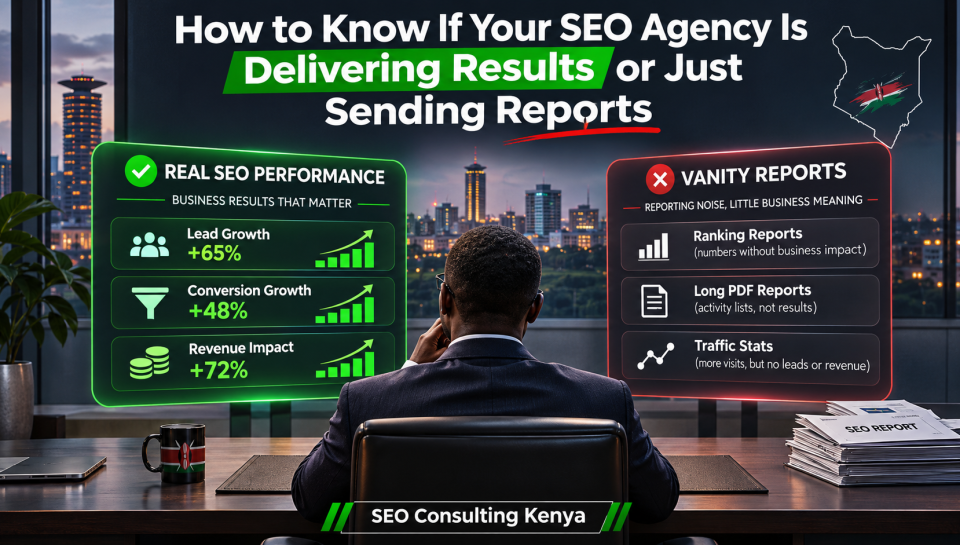
How to Know If Your SEO Agency Is Delivering Results or Just Sending Reports
Your SEO agency sends a report every month. There are colourful charts, lists of keywords, technical scores and perhaps a reassuring upward arrow. But when you ask what all of this means for your business, the answer is less clear. Are you paying for measurable progress, or for a polished description of activity?
For a Kenyan company spending money on SEO every month, that distinction matters. Rankings and search traffic can be valuable signs of progress, but they are not interchangeable with qualified enquiries, revenue or completed work. The right way to assess an agency is to connect its contractual responsibilities to reliable evidence, then judge whether the strategy is moving the business closer to an agreed outcome.
Key takeaways
- A useful SEO report explains what changed, why it changed, what was delivered and what happens next.
- Review your agency’s results using accounts and measurements the business controls, not screenshots alone.
- Separate output metrics (audits, fixes, content) from search outcomes (visibility, clicks) and business outcomes (qualified leads, sales).
- Judge early-stage implementation and longer-term results differently; no ethical agency can guarantee a particular Google ranking.
- Use a written accountability scorecard to identify missing evidence, poor communication and decisions that require a change of strategy.
The problem with judging SEO by how busy an agency looks
Imagine a fictional Nairobi professional-services firm receiving a report showing 20 new blog posts, 35 optimised keywords and 15 links acquired. The figures may describe legitimate work. They do not, without additional evidence, show whether the firm is appearing for commercially relevant searches, whether its important service pages are improving, or whether prospective customers are contacting the business.
The opposite mistake is also possible. A technically difficult website might require weeks of indexing repairs, site-structure changes and analytics implementation before its most important opportunities can be measured. Dismissing that work simply because enquiries have not increased in the first month would be unfair. Accountability is therefore not a single ranking target. It is a chain of evidence linking the agreed work to sensible performance indicators.
Three levels of SEO performance every client should separate
Level one: Work completed
These are deliverables the agency can control directly, subject to site access and approvals: keyword mapping, technical audits, implemented corrections, improved service pages, content production, internal linking and tracking configuration. Ask for the URL, issue, change date and validation evidence where applicable. A claimed technical fix is stronger when it is backed by a test or crawl rather than a line in a spreadsheet.
Level two: Search performance
Google Search Console helps you inspect clicks, impressions, search queries, pages and the countries from which search visibility originates. You may also monitor non-branded commercial searches separately from searches for your company name. An increase in searches for the brand alone may reflect offline activity, advertising or existing demand—not necessarily better discovery by new customers.
Search results are influenced by competition, demand, seasonality, algorithm changes and many other factors outside an agency’s complete control. Look for patterns in relevant landing pages and search terms, not isolated daily ranking movements. The same keyword can also mean different things to people in different locations or stages of buying.
Level three: Business outcomes
A website may receive more visitors while producing fewer qualified enquiries. Your business should define what counts as a genuine lead: a completed quotation request, a relevant phone enquiry, a qualified WhatsApp conversation or another verified sales opportunity. Connect this definition to business records where possible, rather than reporting button clicks as confirmed prospects.
Google Analytics 4 provides recommended events including generate_lead, qualify_lead and close_convert_lead. These events require appropriate implementation and, for later-stage sales events, a dependable process for sending or reconciling data from the business. They are not automatically proof that a sale occurred simply because a web analytics dashboard displays a number.
The SEO Agency Accountability Scorecard: a 100-point framework
Use the scorecard below for a structured discussion, not as a scientific rating or a guarantee of commercial success. Assign each area a score between zero and its maximum based on documented evidence. Adjust the weights to suit your contract and business model before using it to compare providers.
| Area | Maximum | What strong evidence looks like |
|---|---|---|
| Agreed strategy and priorities | 15 | Documented audience, service-page priorities, baseline and quarterly plan |
| Delivered work and technical validation | 20 | Change log, URLs, completed tasks, testing and approvals |
| Relevant search visibility | 15 | Search Console trends for agreed commercial pages and queries |
| Lead and commercial measurement | 25 | Verified leads, qualification criteria, source data and attribution limitations |
| Reporting transparency and access | 15 | Client-owned access to Search Console, GA4 and clear interpretation |
| Next actions and accountability | 10 | Named owner, priorities, dependencies and review dates |
| Total | 100 | Score the evidence available—not the agency’s confidence |
A missing sales measurement system should be recorded as a measurement gap, not automatically scored as zero sales. Likewise, when the client’s own team has delayed publishing or technical approval, the review should distinguish agency delays from client-side dependencies. The purpose of the framework is to reveal what needs attention, not to manufacture an accusation.
How to interpret the score
- 80–100: Strong evidence and governance, subject to checking that the performance goals are realistic.
- 60–79: Some important evidence exists, but discuss the missing measurement or delivery gaps.
- 40–59: Significant uncertainty about outcomes, responsibilities or implementation.
- Below 40: Request a documented recovery plan and independent validation before committing further spend.
These ranges are editorial decision aids created for this article; they are not an industry-certified scoring system or published statistical benchmark. A low score may indicate weak reporting as much as weak performance. Interpret it alongside the contract, stage of engagement and business context.
What a useful monthly SEO report should actually contain
| Report section | What it should tell the business owner |
|---|---|
| Executive summary | What improved, what declined and why it matters |
| Completed work | Exactly which pages or systems changed and how the work was validated |
| Search demand and visibility | Relevant impressions, clicks, queries, top pages and meaningful comparisons |
| Lead and revenue signals | Verified enquiries, qualified leads, sales where measurable, and limitations |
| Risks and dependencies | Issues waiting on developer access, content approval, competition or data quality |
| Next-month plan | Three to five prioritised actions, owners, deadlines and expected indicators |
A chart without a decision is not always useless, but an executive report should turn observations into action. If a service page attracts qualified traffic but generates no enquiries, the next recommendation might be to inspect its offer and form. If important pages have indexing problems, the priority may be a technical correction. If measurements are unreliable, the first job is to fix the measurement process.
Five questions to ask at your next agency review meeting
- Which three changes did you make this month that are most likely to affect our commercial goals, and where can we verify them?
- Which important search queries or landing pages improved or declined, and what evidence supports your explanation?
- How many enquiries can we verify from organic search, and how many were qualified? What cannot yet be measured reliably?
- What did not work as expected, and what will you change as a result?
- What do you need from us next month, who is responsible and when should we review the outcome?
Pay attention to how the agency handles uncertainty. A trustworthy consultant should be able to distinguish an established fact, an informed interpretation and a hypothesis requiring testing. Defensiveness, unexplained guarantees and repeated reliance on screenshots instead of direct access are warning signs. So is the absence of any strategy adjustment after several reporting cycles.
How soon should an SEO agency demonstrate results?
There is no universal deadline for rankings or leads. A newly launched site in a competitive market is not comparable to an established business fixing an indexing error. The appropriate review calendar should be agreed before the engagement begins and reassessed when circumstances change.
First 30 days: evidence of understanding and implementation
Look for an initial baseline, site assessment, documented priorities, confirmed access, valid measurement definitions and completed quick wins where feasible. Do not demand a guaranteed ranking increase in the first month.
Around 60–90 days: evidence that the plan is being executed
Review the technical and content changes already live, whether important pages can be indexed, whether tracking works, and which early search or engagement indicators are moving. Where performance is unchanged, expect an explanation and a testable next step.
After several months: evidence of commercial direction
Assess trends across comparable periods, relevant searches, priority landing pages and genuine leads. Use longer windows when search demand is seasonal or sales take months to close. An unchanged result is not automatically a failed agency, but persistent stagnation without diagnosis is a legitimate concern.
A Kenyan business example: the missing WhatsApp enquiry
Consider a hypothetical home-services company advertising an increase in search traffic. Its agency reports that users clicked the WhatsApp button 120 times. The sales manager says the business received only 18 relevant messages. The discrepancy may reflect people abandoning before sending, repeated clicks, attribution differences or incorrect tracking. Without validating the hand-off, neither number should be labelled 120 qualified leads.
The practical response is to test the link, review event definitions, inspect received messages with appropriate privacy safeguards and establish a simple lead classification process. This is a stronger response than claiming victory on traffic or blaming the sales team without evidence. The example is hypothetical and not an SEO Consulting Kenya client result.
Red flags that warrant further investigation
- Reports focus exclusively on rankings, domain scores or numbers of tasks without showing relevant page or business outcomes.
- Your business does not have suitable access to its own Search Console and Analytics accounts.
- The agency repeatedly claims guaranteed first-page rankings or certainty about algorithm changes.
- Work is described as completed but no URLs, records or validation are supplied.
- Losses are attributed to Google updates without reviewing other plausible causes.
- There is no clear explanation of what happened to enquiries, or why lead tracking is not yet reliable.
- The strategy never changes even when evidence repeatedly contradicts its assumptions.
One warning sign alone may have an innocent explanation. Start with documented questions and a reasonable opportunity to clarify. If an agency is still undertaking agreed foundational work, measure that work fairly before expecting the financial impact of a mature search programme.
When to keep, change or replace your SEO agency
Continue when the strategy is coherent and evidence is improving
A good reason to continue is a clear plan, verified deliverables, transparent access and credible progress toward agreed priorities. Some important improvements may take time to influence customer acquisition.
Request a revised plan when progress or evidence is inadequate
Ask for a concise recovery plan identifying the problem, the proposed change, the business owner’s dependencies and a review date. This is often better than abruptly switching providers without understanding whether the obstacle is technical, commercial or organisational.
Consider an independent audit when confidence has broken down
An independent review can check whether technical work was completed, whether the keyword strategy matches your customers, whether content overlaps or misses important service intent, and whether analytics tell a reliable story. The reviewer should examine actual assets and accounts, not simply repeat the original agency’s conclusions.
Frequently asked questions
Which SEO KPIs matter most for a Kenyan service business?
Prioritise relevant organic search visibility, qualified enquiries and, where verifiable, sales opportunities or revenue. Support these with technical implementation evidence, important landing-page trends and accurate lead measurement. The correct mix depends on the sales process and available data.
Should I fire my SEO agency if rankings fall?
Not based on one isolated movement. Investigate the affected queries and pages, changes to search demand or competition, tracking accuracy, technical incidents and the timeframe. Require a reasoned response rather than an immediate guarantee of recovery.
Can SEO agencies guarantee leads?
An agency can agree to specific deliverables and performance goals, but the actual number of leads depends on demand, search systems, the website offer, competitors and the business’s response process. Guaranteed outcomes should be scrutinised carefully.
Who should own Google Search Console and Google Analytics?
The client business should retain appropriate ownership or administrative control of its properties and grant the agency the permissions needed for the work. Access and handover arrangements should be documented in the engagement.
Judge your agency by decisions, not dashboard decoration
The most valuable monthly SEO report is one that helps you answer four questions: What did we pay for? What actually happened? What does the evidence mean? What should we do next? The purpose of reporting is not to make a marketing activity look impressive; it is to make investment decisions more informed.
If you need an independent view of your website, start with SEO Consulting Kenya’s free preliminary SEO audit. It checks public page-level SEO issues rather than verifying your agency’s entire programme. For a deeper review of strategy, implementation and reporting, explore our SEO consulting services or contact us to discuss your requirements.