


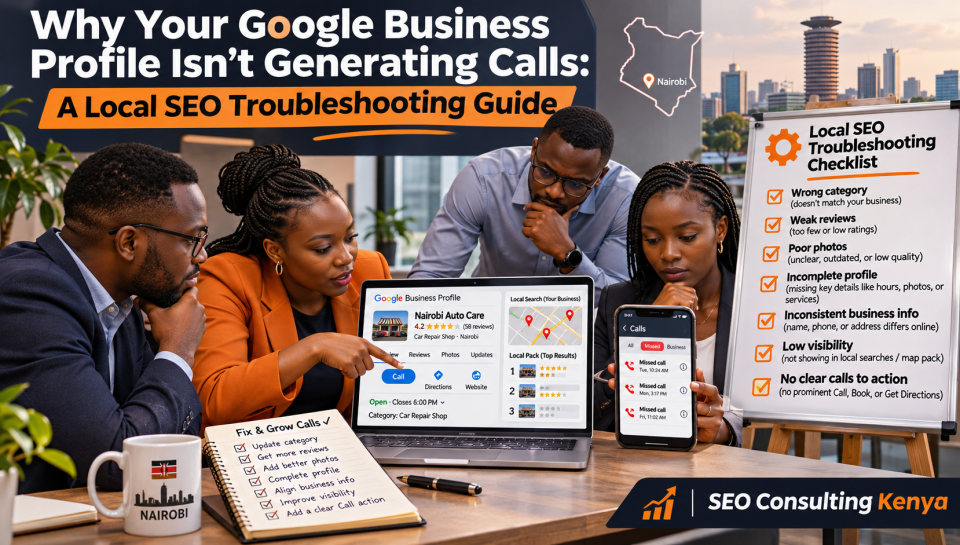
Why Your Google Business Profile Isn’t Generating Calls: A Local SEO Troubleshooting Guide
Your business shows up on Google Maps. The photos look good, the address is correct, and the performance report records people viewing your listing. Yet the phone barely rings. Is Google hiding your business? Are your competitors doing something better? Or are interested customers struggling to contact you?
The answer depends on where the customer journey stops. Visibility is not the same as intent. A tap on the call button is not the same as an answered call. And an answered call is not necessarily a qualified enquiry. Before paying for more Google Business Profile optimisation, work out which of those steps is failing.
Key takeaways
- Google says local rankings are primarily influenced by relevance, distance and prominence—not a paid shortcut to the top.
- The Calls metric in Google Business Profile Performance records clicks on the call button, not completed or answered conversations.
- A business with few profile views needs a different diagnosis from a business with many call clicks but few actual conversations.
- Accurate categories, business details, real photos and genuine reviews can help customers assess whether your business is relevant and trustworthy.
- Measure received calls and qualified enquiries alongside Google Business Profile interactions before judging commercial performance.
First: what does ‘no calls from Google’ actually mean?
Google Business Profile Performance can report profile views, search terms, call-button clicks, website clicks and other available interactions. Google explicitly defines Calls as the number of times someone clicked the call button. It does not establish that your phone rang, that someone answered or that the caller was a prospective customer. Its older Business Profile call history feature was discontinued in July 2024.
Start by distinguishing three situations: your listing is hardly seen; it is seen but rarely prompts contact; or people attempt contact and you do not receive useful enquiries. Those situations can produce the same complaint—’Google isn’t bringing customers’—but need different solutions.
The Local Enquiry Leak Framework: five stages to investigate
Stage 1: Discovery — are local customers finding the business?
Open the Performance section of your verified Business Profile and review trends in views and search terms. Compare comparable periods rather than isolated days. Look for searches that describe your actual products, services and location. A business that appears mainly for its own brand name may be easy for existing customers to find without being visible enough to new buyers.
Google describes local ranking through relevance, distance and prominence. Relevance is how closely your profile matches a query, distance concerns proximity to the searcher, and prominence reflects how established or well-known a business appears. Location naturally constrains what you can achieve. A company in Westlands cannot expect to rank uniformly for every search made across Nairobi, regardless of how carefully the profile is optimised.
Stage 2: Relevance — is the listing attracting the right search intent?
A profile can earn views from people who are not ready to call. Someone searching for a restaurant’s opening hours may only want to check whether it is open. Someone looking for directions may intend to visit instead of calling. For a plumbing company, a search for emergency plumbing services has a different intent from a search for general DIY plumbing advice.
Audit your primary category, applicable additional categories, service descriptions, products where eligible and linked website content. Use your real business name, not a list of keywords inserted into the name field. Accurate information helps Google understand the business and helps customers recognise whether you provide what they need.
Stage 3: Confidence — does the profile give people a reason to choose you?
A prospective customer may see your profile next to several competitors. Missing service information, outdated hours, unclear photographs, inconsistent contact details or unanswered concerns can make it hard to decide whom to approach. Use genuine photos of your premises, team or work where appropriate, accurate hours and a clear explanation of your services.
Encourage honest reviews from real customers without buying, gating or incentivising positive feedback. Respond professionally to feedback when appropriate. Reviews contribute to the information available to potential customers and, according to Google, review count and ratings can influence local prominence. They are not a formula for guaranteed ranking or sales.
Stage 4: Contact — can someone actually reach your business?
Check the primary phone number from a separate device. Is it correct, connected and answered during advertised business hours? If calls route through a switchboard, verify that the right team receives them. Test your website link, quote form and mobile contact experience. Do not rely solely on a screenshot showing the correct number.
For a Kenyan SME, the preferred contact journey may include calling, a website enquiry form, an approved messaging option or visiting the location. Do not assume that Google Business Profile’s former chat feature is still available; Google ended that feature in July 2024. Where you invite WhatsApp conversations through an eligible link or your website, validate the actual customer journey and its availability rather than relying on legacy messaging instructions.
Stage 5: Response — are attempted calls becoming qualified enquiries?
A call may arrive unanswered, be answered after a long delay, or end without anyone recording the customer’s needs. When staff classify enquiries, distinguish genuine buying interest from wrong numbers, suppliers, job applications and existing-customer support. A visible profile may be performing acceptably while the business’s response process is losing opportunities.
If you cannot track outcomes precisely, start with a simple call register: date, source if known, whether answered, customer need, whether qualified and next action. Respect privacy requirements and do not record customer conversations without appropriate legal and operational safeguards.
Match the symptom to the next diagnostic test
| Symptom | Plausible explanation | Best next check |
|---|---|---|
| Very few profile views | Poor discoverability or limited relevant local demand | Verification, search terms, category, local competitors |
| Many views, few call clicks | Research or directions intent; insufficient trust | Search intent, photos, reviews, hours, services |
| Many call clicks, few received calls | Abandoned dial action, wrong number or telephony problem | Live phone tests and call logs |
| Answered calls but few viable prospects | Low-quality enquiry mix or unclear service offering | Call classification and service descriptions |
| Good enquiries but few sales | Response, pricing, availability or sales process | Follow-up speed and qualified-lead outcomes |
How to measure actual call performance without inventing precision
Suppose a hypothetical local services company records 1,000 Business Profile views, 40 call-button clicks, 25 calls received and 10 qualified enquiries over a comparable reporting window. The 40 clicks are Google interactions, not 40 conversations. The 25 received calls might include repeat callers or other sources unless call attribution is reliable. The 10 qualified enquiries should be verified from business records, not estimated from clicks alone.
These figures are an illustration, not a client case study or an accepted industry benchmark. They also cannot automatically be placed into one causal funnel: a person viewing the profile might contact the business later by searching the name or visiting the website. Document what is known and what remains uncertain.
For businesses with access to suitable tracking tools, linking Business Profile and Google Analytics can help bring selected local performance metrics into a broader reporting workflow. Google’s current documentation describes this integration, but it is not a substitute for verifying the actual calls and qualified leads received.
Seven days to diagnose a quiet Google Business Profile
- Day 1: Confirm profile eligibility, verification, ownership and accurate business details.
- Day 2: Export or record recent Performance metrics and identify search terms that match your customers.
- Day 3: Compare a few relevant local competitors from realistic search locations; avoid treating one manual search as a definitive ranking test.
- Day 4: Review photos, services, hours, reviews and contact clarity from a first-time customer’s perspective.
- Day 5: Test phone calls, links, forms and relevant mobile contact paths using a separate device.
- Day 6: Review call logs and classify received enquiries, missed calls and follow-up outcomes.
- Day 7: Select the most strongly evidenced problem, assign an owner and plan a measurement review after enough time has passed.
A seven-day audit is a way to identify immediate issues, not a guarantee that Google rankings or enquiries will improve in one week. Some changes require Google’s review, and small businesses may need longer periods to collect meaningful data.
What you should fix first
If the profile is not being found
Confirm eligibility and verification, then correct the primary category and core information. Make sure your website explains relevant services and service locations. Review whether competitors are genuinely more suitable matches in the areas you are targeting. Do not pay anyone who promises to purchase a higher local ranking: Google says that cannot be done.
If people see the profile but do not engage
Make the offering easier to understand. Improve authentic service descriptions and visual evidence, keep hours current, resolve contradictory business details and respond constructively to legitimate customer feedback. Test whether the location serves the intended buyers; distance may be a more important constraint than the profile description.
If call clicks are recorded but no one answers
Treat this as an operational problem until the phone path has been tested. Investigate routing, staffing, after-hours behaviour and logs. If callers consistently cannot reach the business, spending more on visibility may simply increase abandoned attempts.
If calls arrive but customers do not convert
Review the quality of the enquiries and what staff do with them. Are prices or availability communicated clearly? Are callbacks promised but not made? Does the business offer what the listing appears to promise? Fix the expectation or follow-up gap before blaming Google Maps.
Three mistakes Kenyan businesses should avoid
- Creating or presenting fake locations to appear closer to customers. A service-area business must represent how it really operates and follow Google’s eligibility and address rules.
- Buying reviews or offering rewards only for positive ratings. Authentic trust signals matter more than manipulating the review profile.
- Confusing higher profile views or call clicks with guaranteed sales. Genuine customer acquisition depends on matching intent, accessibility and commercial follow-through.
How your website and Google Business Profile should work together
Your profile helps people find and evaluate the business in local results. Your website can answer detailed questions that do not fit in a profile: service scope, project examples, service areas, pricing approach and quotation requirements. A website click should lead to a relevant, mobile-friendly page, not an unrelated homepage when a dedicated service page exists.
If visitors reach the site but do not enquire, our traffic-without-leads diagnostic guide explains how to investigate that next stage. If you are assessing an SEO provider, the SEO agency accountability scorecard can help you distinguish reports from verified business progress.
Frequently asked questions
Why does my Google Business Profile have views but no calls?
Views mean people encountered the profile; they do not prove calling intent. Check search terms, business relevance, completeness of information, customer trust and whether the phone link works. Some customers may choose directions or the website instead.
Does Google Business Profile count actual phone calls?
Its Business Profile Performance Calls metric represents call-button clicks. It does not by itself verify a completed, answered or qualified call. Google removed the separate Business Profile call-history feature in July 2024.
Can I pay Google to rank my Business Profile higher in Maps?
You can advertise through Google Ads where eligible, but Google says there is no way to request or pay for a higher organic local ranking. Local ranking depends primarily on relevance, distance and prominence.
Will adding more keywords to my business name improve rankings?
Your profile name should reflect your real-world business name. Adding unrelated keyword strings or locations to manipulate visibility can violate Google’s business representation rules. Improve categories and accurate service information instead.
How long should I evaluate changes to a Business Profile?
The appropriate review period varies with local demand, seasonality and how much data your profile receives. Validate immediate errors quickly, but judge visibility and call trends over comparable periods and avoid promising an exact improvement date.
The right goal is not more profile views. It is easier access to your business.
A useful Google Business Profile helps the right nearby customers understand what you do, trust your information and reach you successfully. If calls are missing, do not start by chasing a ranking trick. Find out whether the business is being discovered, evaluated, contacted and answered—and fix the first meaningful break.
SEO Consulting Kenya provides Google Business Profile optimisation services, including profile reviews and agreed improvements. If you need help identifying whether the problem lies with local visibility or the customer contact experience, contact our team to discuss an appropriate review. Google controls verification and ranking decisions; no provider can guarantee calls or Maps positions.