


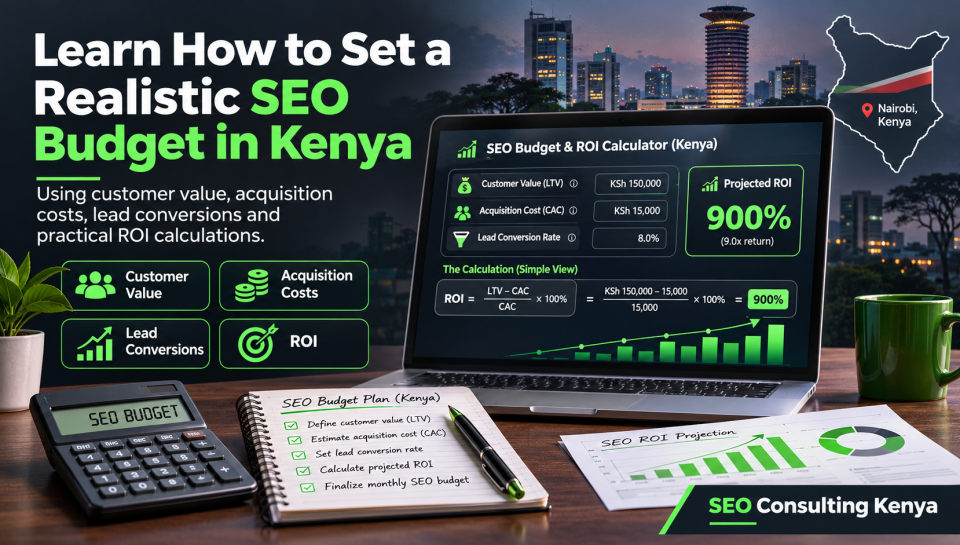
How Much Should a Kenyan Business Invest in SEO? A Practical ROI and Budgeting Framework
How much should your business spend on SEO each month: KSh 20,000, KSh 65,000 or more than KSh 100,000? Most pricing guides answer by listing agency packages. That tells you what SEO companies charge. It does not tell you what your business can afford, what the investment needs to achieve or whether SEO is the right next expense.
A sensible SEO budget starts with your business economics, not an agency’s rate card. You need to know how much profit a new customer contributes, how many qualified enquiries become paying customers, which demand you can realistically capture and how long you can sustain the investment before judging its contribution. Only then can you compare proposals meaningfully.
Key takeaways
- Start with gross profit contribution per customer, not revenue or website traffic alone.
- Work backwards from customer value, expected lead-to-sale conversion and a realistic time horizon to estimate your affordable acquisition cost.
- Account for agency fees, development, content, tracking and internal time when evaluating the total SEO investment.
- Compare scenarios rather than accepting rankings, leads or revenue projections as guarantees.
- If your website cannot convert interested visitors or handle enquiries reliably, fix those issues before increasing SEO expenditure.
Why ‘What does SEO cost?’ is the wrong first question
An SEO package can be inexpensive and still be poor value if it does not solve the business’s main problem. An expensive programme can be reasonable for a company with strong margins, high customer value and several viable markets. The price alone does not tell you whether an investment is good.
Recent Kenyan pricing guides list a wide range of packages and deliverables, and one published analysis of 50 providers reported a mean monthly SEO fee of KSh 82,570 using prices collected in January 2025. Those figures illustrate variation in advertised packages, not a universal fair price for your specific project or a current guaranteed market average.
SEO Consulting Kenya currently lists monthly plans at KSh 35,000 for Foundation, KSh 65,000 for Growth and KSh 95,000 for E-commerce. These are agency-published offers, not independent market benchmarks. The useful question is what each scope can deliver against your business requirements and how you will assess progress.
The Profit-to-Pipeline SEO Budget Framework
Use the following five-step framework before deciding on a monthly SEO fee. It can also be used to challenge optimistic proposals from any provider, including ours.
Step 1: Calculate contribution profit per new customer
Start with revenue from the sale or expected customer relationship, then subtract direct costs required to deliver it. This leaves a contribution figure that can help pay for acquisition and fixed overheads. Avoid using the full selling price as if it were profit.
For example, imagine a fictional Nairobi B2B service business charges KSh 120,000 for a project and incurs KSh 72,000 in direct delivery expenses. Contribution profit is KSh 48,000 per project before marketing spend and shared overheads. For a recurring contract, estimate contribution across the expected customer lifetime while allowing for churn, support and collection risk.
Step 2: Decide how much contribution you can invest in acquisition
Suppose the business can allocate up to KSh 20,000 of that KSh 48,000 contribution to winning a customer. This is its illustrative maximum acquisition cost, not a standard benchmark. The remaining contribution still needs to cover overheads, taxes and business profit. A different business with different margins should choose a different threshold.
An acquisition ceiling should be set with cash flow as well as projected profitability in mind. A company might expect a customer to remain for two years but still struggle to finance twelve months of marketing before revenue materialises.
Step 3: Convert the acquisition ceiling into an enquiry value
Next, consider how many qualified enquiries turn into customers. If a business closes one customer for every four qualified enquiries, the lead-to-customer conversion rate is 25%. At a KSh 20,000 maximum acquisition cost, each qualified lead has an expected acquisition-budget allowance of KSh 5,000 (20,000 × 25%), assuming the conversion rate is representative.
This does not mean each website form submission is worth KSh 5,000. A qualified lead must meet your sales criteria, and some leads come from returning customers or other marketing channels. You need a consistent method for separating raw interactions, verified enquiries, qualified opportunities and closed customers.
Step 4: Estimate the additional customers the investment must produce
If the all-in monthly SEO investment is KSh 65,000 and each additional customer contributes KSh 48,000 before acquisition costs, two additional customers would produce KSh 96,000 of contribution, exceeding the monthly marketing cost by KSh 31,000 before overhead allocation. One additional customer would not cover the KSh 65,000 investment. These are deliberately simplified hypothetical figures, not forecast results.
For financial evaluation, use cumulative acquisition and contribution across an agreed period rather than pretending each month’s SEO fee must be recovered by that same month’s organic leads. SEO work can continue influencing search demand after an invoice is paid, while content production and technical improvements may require upfront effort.
Step 5: Build conservative, base and optimistic scenarios
Do not present one predicted traffic number as certainty. Model a range of plausible qualified leads and resulting sales, showing what assumptions would have to be true to produce each scenario. These are planning tools, not promises.
| Illustrative monthly steady-state scenario | Conservative | Base | Optimistic |
|---|---|---|---|
| Additional qualified enquiries | 2 | 6 | 10 |
| Lead-to-customer conversion | 25% | 25% | 25% |
| Expected additional customers | 0.5 | 1.5 | 2.5 |
| Contribution per customer | KSh 48,000 | KSh 48,000 | KSh 48,000 |
| Expected incremental contribution | KSh 24,000 | KSh 72,000 | KSh 120,000 |
| All-in SEO investment | KSh 65,000 | KSh 65,000 | KSh 65,000 |
| Contribution less investment | -KSh 41,000 | KSh 7,000 | KSh 55,000 |
The fractional customer counts are statistical expectations over time, not literal half-customers. This is a simplified steady-state comparison: it excludes attribution uncertainty, customer churn, taxes, capacity constraints, delayed payment and the months before meaningful SEO outcomes may emerge. It should not be used as a forecast without actual business data.
The three calculations that matter more than keyword rankings
Maximum affordable cost per customer
Maximum affordable customer acquisition cost = contribution profit per customer × the share available for acquisition. If acquisition needs to be recovered within a defined period, use only contribution expected during that period.
Expected value of a qualified lead
Expected acquisition allowance per qualified lead = maximum acquisition cost per customer × qualified-lead close rate. This helps you determine whether an increase in relevant enquiries has enough commercial value to justify investment.
Cumulative ROI across the evaluation period
SEO contribution ROI = (incremental gross contribution attributable to SEO − total SEO investment) ÷ total SEO investment × 100. Use contribution rather than gross sales revenue so the measure does not confuse turnover with return. Include all material acquisition and implementation expenses, and clearly state how SEO-attributed value was estimated.
Attribution is imperfect. A prospective client may discover your business through organic search, compare you on Google Maps, return directly and then call. Document your attribution rules, cross-check CRM and sales records, and avoid treating an analytics channel label as proof of causality.
What should count in your SEO budget?
| Cost area | Examples | Why it matters |
|---|---|---|
| Agency or consultant fee | Technical work, planning, content optimisation and reporting | Usually the most visible recurring charge |
| Content production | Subject expertise, writing, editing, design and supporting research | Quality content may require specialist input and review |
| Development and implementation | Templates, redirects, speed improvements, structured data and fixes | An audit delivers little value when problems remain unresolved |
| Analytics and tracking | GA4, Search Console, call or CRM integrations and data validation | Unreliable measurement obscures results |
| Internal time | Approvals, staff interviews, sales follow-up and coordination | Real resource cost even when absent from an agency invoice |
| One-off setup costs | Site audit, migration preparation or analytics overhaul | Can make early months more expensive than ongoing work |
Ask every prospective provider to identify what its quotation includes, what depends on external developers, what assets you will own and what additional costs may arise. A low retainer with recurring unquoted implementation fees can become more expensive than a higher-priced but comprehensive scope.
Three Kenyan business situations with different budget decisions
A small local service business with inconsistent enquiries
For a single-location plumber, clinic or home-services provider, the most immediate improvement may be accurate contact details, a useful Google Business Profile, clear location-focused service pages and a working call or WhatsApp experience. A large content-production retainer may not be the first sensible expense. Start by addressing the highest-impact confirmed gaps.
A professional-services firm with high-value contracts
A firm selling legal, consulting, engineering or B2B services may recover acquisition investment from relatively few clients, but its sales cycle may take months. A commercially focused SEO programme should prioritise service intent, authoritative explanations, case evidence and the quality of enquiries rather than raw monthly traffic.
An e-commerce company with many products
An online store faces additional challenges: category and product indexing, filters, stock availability, product content, purchase experience and return rates. An SEO plan can appear successful on product impressions while margins are eroded by fulfilment costs or returns. Track contribution profit from incremental orders, not turnover alone.
How to choose between KSh 35,000, KSh 65,000 and KSh 95,000
The right package depends on scope and readiness, not simply company size. SEO Consulting Kenya’s published Foundation plan is focused on a smaller number of priority pages and initial improvements. Growth covers a broader service-business programme including conversion-tracking configuration. The E-commerce plan focuses on product and category discovery and store-specific technical issues. Confirm the current inclusions before signing, as service descriptions and prices can change.
- Choose a tightly scoped engagement when the site is small, key technical issues are known and commercial pages need prioritisation.
- Consider a wider ongoing programme when multiple service pages, markets or content opportunities justify sustained activity.
- Use an e-commerce-specific scope when product discovery, category architecture, duplicate URLs and purchase tracking are central to the business.
- Commission a one-off audit or measurement repair first when you cannot confidently identify which problem SEO should solve.
A provider should explain what it will not do within a package. Scope boundaries, responsibilities and delivery evidence are more meaningful than the length of a services checklist.
When you should not increase your SEO budget yet
There are circumstances where spending more on search optimisation is premature. If enquiries are not being answered, the contact form is broken, the offer is unclear or the company cannot serve additional customers profitably, more visitors may magnify an existing problem.
Start with a traffic-to-leads diagnosis if your site already attracts visitors but few genuine buyers. If you have an agency and are unsure what its reports prove, use our SEO agency accountability guide before expanding the contract.
Another reason to delay is cash-flow risk. SEO is not an appropriate substitute for an immediate sales channel when a business cannot sustain the agreed programme or wait for results to develop. Consider short-term demand generation alongside improving the website, and assess the economics of both.
A practical 90-day budgeting process
- Days 1–15: Establish baseline enquiries, qualified leads, sales, gross contribution and existing organic search visibility.
- Days 16–30: Audit search demand, site issues, competition and commercial landing pages; agree priorities and total implementation cost.
- Days 31–60: Complete and validate the highest-impact changes, improve conversion tracking and confirm the sales follow-up process.
- Days 61–90: Review delivered work and early signals, then revise the assumptions behind your longer-term commercial scenarios.
- After 90 days: Continue monitoring across a horizon appropriate to your industry; distinguish implementation progress from proven incremental profit.
The 90-day plan is a governance schedule, not a promise that search rankings or sales will improve in three months. Some businesses need more time to collect enough evidence, particularly in competitive sectors or with low search demand.
Questions to ask before approving an SEO proposal
- Which commercial customer segment and search intent will your work prioritise?
- What site changes, content and measurement work are included—and excluded—from the quoted fee?
- What assumptions about qualified leads, close rates and profit make the proposed budget reasonable?
- What is the realistic evaluation period, and which results are controllable deliverables versus external outcomes?
- Who owns Search Console, Analytics, content and access credentials?
- If the original assumptions prove wrong, how will the programme change?
Frequently asked questions
What is a reasonable SEO budget for a small business in Kenya?
There is no single correct figure. Published Kenyan plans vary widely, while the right commitment depends on the site’s needs, competitive environment, customer value and ability to sustain the work. Begin with a financially defensible acquisition budget, then request a scoped proposal.
How much does SEO cost per month in Kenya?
Kenyan providers advertise a wide range of retainers. SEO Consulting Kenya currently lists Foundation at KSh 35,000, Growth at KSh 65,000 and E-commerce at KSh 95,000 per month. For broader price comparisons and service inclusions, see our existing SEO pricing guide.
Is SEO cheaper than Google Ads?
Not necessarily, particularly during the setup phase. SEO and paid advertising have different cash-flow patterns, timelines, operational costs and attribution limitations. Compare cost per incremental qualified customer over an appropriate horizon, rather than assuming organic visits are free.
How long before SEO pays for itself?
The timing depends on the baseline, market, competition, technical condition, sales conversion and customer margins. No ethical provider can promise an exact break-even date. Build conservative and optimistic scenarios, monitor leading indicators and review actual customer contribution over time.
Should I pay for SEO if my business has very little traffic?
Possibly, if relevant search demand exists and the website is technically ready to capture it. First verify the market and unit economics. Low traffic alone is not enough evidence that an ongoing SEO retainer is the best investment.
Treat SEO as an investment decision, not a monthly subscription to rankings
The important question is not whether you can find an agency with a lower price. It is whether a clear programme of work can reasonably attract and convert customers whose contribution justifies its full cost. Begin with business economics, test your assumptions, insist on transparent delivery and stay willing to change the plan when the evidence changes.
If you want to understand your website’s starting point, request a free SEO audit from SEO Consulting Kenya. For an estimate aligned with your goals and budget, review our current SEO service plans or speak with our team.